A product name has a small but demanding job. It has to survive a spoken introduction, fit into documentation, and give a buyer enough context to ask the next sensible question. For an automation API, that context matters because the same market contains visual editors, integration services, background job runners, and developer libraries. A name that suggests the wrong interaction can make the first conversation longer.
Start with the product’s actual entry point. Does a customer write code, install a command-line tool, connect accounts in a browser, or hand a process to a service team? Naming should follow that answer. A product used through an API can still have a dashboard, but the dashboard may be an inspection surface rather than the thing the buyer is purchasing.
This guide offers a small evaluation exercise, not a promise that one style of name will outperform another. The examples are hypothetical. The aim is to make a naming decision easier to discuss with evidence from likely buyers.
Write the product sentence before the shortlist
Complete this sentence in ordinary language: “A [buyer] uses this to [action] when [situation].” For example, a platform engineer uses the product to start and inspect background jobs when a customer action needs work that cannot finish inside a request. That sentence is specific enough to evaluate a name against.
Avoid putting every future capability into the sentence. A company may eventually offer connectors, scheduling, approvals, and reporting. The first buyer still needs a reason to pay attention now. If the team cannot agree on the action, the disagreement probably belongs in product positioning before it belongs in naming.
Keep a second sentence for the buying context. Who introduces the tool internally, and who approves its use? A developer may share a documentation link with a technical lead, while a security reviewer asks about data access. The name should remain recognizable across those conversations even as the supporting explanation changes.
Distinguish a company name from an interface label
Some names identify a broad business. Others sound like a button or a feature. Neither category is automatically wrong, but confusing them can create awkward language. Say the candidate in a support introduction, an invoice description, and a documentation heading. Does it work as the identity of the provider, or only as the name of one action?
A hypothetical name such as “Run This” might work as a command label but require explanation in a procurement conversation. A very broad corporate name may work on a contract yet say little about the developer task. The test is not whether a phrase sounds clever in isolation. It is whether it remains useful in the places customers will actually encounter it.
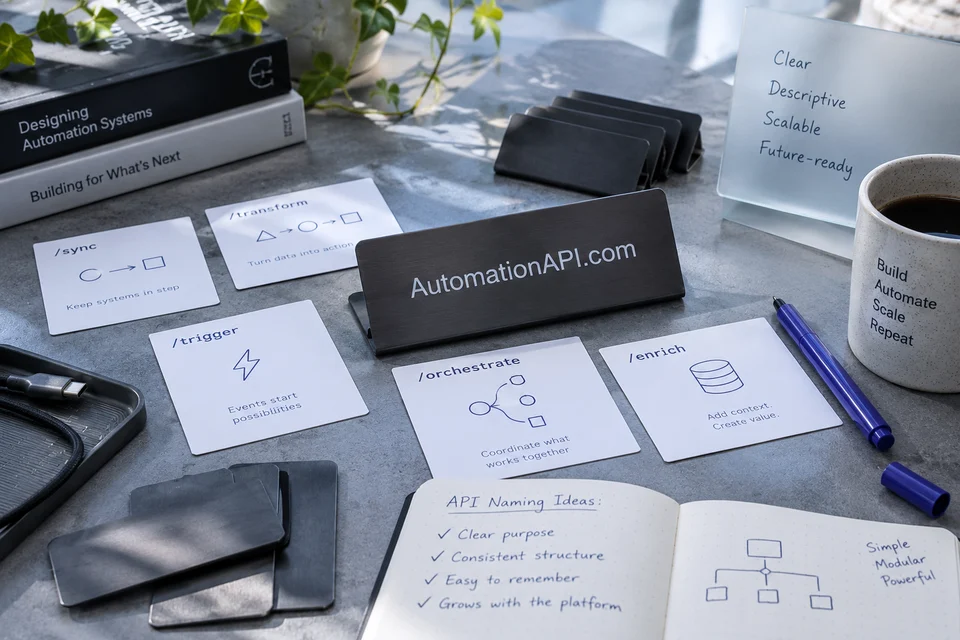
AutomationAPI.com is an example of a descriptive category address. Its fit depends on a business genuinely centered on automation APIs. A name with that level of specificity creates an expectation, so the product introduction and documentation should meet it. The domain is available for acquisition; the examples in this article do not describe an existing product under it.
Run a spoken handoff test
Choose a small group of people who resemble the intended buyer. Five conversations can expose problems, though they are not a statistically representative study. Read a candidate once in a short product sentence. Ask the listener to repeat it, write it, and explain what kind of product they expect to find.
Do not correct the listener immediately. Record the spelling they choose and the category they describe. If two people add a word, swap a letter, or assume a visual-only tool, that is useful feedback. It does not prove the name is unusable, but it identifies the explanation the brand will have to carry.
Use the same introduction for each candidate so the comparison is fair. Avoid giving a favorite name a polished story while presenting the others without context. Rotate the order if each person hears several options, and ask for the reason behind a preference rather than collecting a simple vote.
Put the name into real surfaces
Create plain mock documents rather than a finished logo. Place the candidate in a browser title, an API quickstart, a support message, a package description, and a short spoken introduction. This exposes practical friction before visual design makes the team attached to one choice.
Check how the full address reads in lowercase as well as in the preferred capitalization. People will not always preserve the brand’s typography. Look for ambiguous letter boundaries and accidental word readings. If a name only works with carefully chosen capital letters, decide whether that burden is acceptable.
For developer products, distinguish the public brand from technical identifiers. The domain, package name, repository name, and command do not have to be identical, but their relationship should be easy to explain. Document any existing collisions before selecting a command that developers may already use for something else.
Check the surrounding market carefully
Search for the candidate in the product category and in adjacent categories. Look at operating businesses, software packages, repositories, and common usage. The purpose is to find potential confusion, not to declare that a search result page settles ownership rights.
For a United States trademark search, the USPTO’s official search resources are a starting point. Domain availability and trademark clearance are different questions. Have an appropriately qualified professional review a serious candidate for the intended markets and services before committing to a launch. This naming exercise is not a legal clearance opinion.
Record what was searched and when, with links to relevant results. A tidy record helps a professional investigate and prevents the team from treating “someone checked it” as a complete answer. Avoid assuming that a descriptive word or an unused domain is automatically free of conflicting rights.
Use a scorecard that permits disagreement
A small scorecard can keep the discussion concrete. Rate category fit, spoken clarity, spelling, scope, and the amount of explanation required. Add a separate unresolved-issues column for conflicts and practical checks. Do not average a serious unresolved issue into an otherwise attractive score.
For example, Candidate A may be easy to pronounce but suggest a consumer app. Candidate B may be more descriptive but difficult to shorten in conversation. The right decision depends on the product and distribution plan. A name seen mainly in developer documentation faces different demands from one introduced repeatedly in live sales calls.
Ask each reviewer to write one sentence explaining the strongest and weakest result. That gives the team something it can act on. A row of numbers without reasons can create a false sense of precision while hiding the actual disagreement.
Set a decision date and a next test
Naming work can expand indefinitely because there is always another possible word. Decide what evidence is enough to choose a candidate, what issues are disqualifying, and who makes the final decision. A short list with clear tests is more manageable than an open collection of favorites.
After choosing a direction, test the product introduction again with fresh readers. Ask what the product does, how they would start using it, and what they would expect to see on the next page. If they can answer those questions, the name and explanation are working together.
The practical next step is simple: take one candidate, one product sentence, and five likely buyers. Record what they heard before explaining what the team intended. That small exercise can turn a subjective naming debate into a set of specific choices.